Technology
April 10, 2026
6 minutes


If you've ever sat across from your family doctor and noticed them typing furiously instead of making eye contact, you've witnessed a small symptom of a much larger crisis.
Canadian family physicians now spend close to 19 hours every week on administrative tasks — nearly 40% of their working time. Across the country, that adds up to roughly 42.7 million hours per year in documentation, forms, and paperwork. Nearly half of that time, physicians say, is spent on tasks they consider unnecessary red tape. More than 1 in 2 report high levels of burnout, and burnout rates today are 1.7 times higher than they were before the pandemic.
A CTV News investigation described the phenomenon as an "administrative tsunami." The physicians quoted weren't mincing words: "It wasn't like this 20 years ago."
The administrative burden isn't just a problem for doctors — it's a problem for everyone who relies on them. When family physicians are buried in documentation, they have less time for actual patient care. And as more doctors exit the profession early or reduce their patient panels, the ripple effects are felt across the healthcare system.
This is exactly the problem Dr. AJ Kadhim-Saleh set out to solve when he co-founded Pippen AI.
Pippen is an AI-powered physician assistant built for family medicine. It listens to clinical encounters, transcribes them in real time, and generates structured clinical documentation — SOAP notes, differential diagnoses, treatment plans, referral letters, and billing codes — in a matter of seconds.
It's PHIPA-compliant, Canadian-hosted, and built by physicians, for physicians. Dr. Kadhim-Saleh isn't just Pippen's founder — he's a practicing family physician and clinic owner in Toronto. He built the tool he wished he had, and that ground-level clinical perspective is baked into every design decision.
Crowdlinker has partnered with the Pippen team since the product's earliest days — working alongside Dr. Kadhim-Saleh and co-founder Mary Aglipay to design, engineer, and scale the platform from initial concept to a fully production-ready tool. It has been the kind of partnership where clinical expertise and product execution sharpen each other: AJ brings day-to-day physician insight, and our team brings it to life.
On April 1, 2026, Pippen launched what is arguably its most impactful feature to date — the Template Library.
Before this launch, Pippen's AI note generation was already fast and accurate. But physicians had limited control over the exact format and structure of the documentation it produced. If your workflow called for something beyond a standard SOAP note — a mental health assessment, a diabetes management visit, a new patient intake — you were largely building from scratch. For a busy clinic, that setup overhead adds up quickly.
The Template Library changes the equation.
At the core of the feature is a growing collection of ready-to-use documentation formats, curated by the Pippen team and organized by encounter type. Out of the box, physicians have access to templates covering:
"Clinicians wanted out-of-the-box templates that make sense, don't make things up, and fit specific types of visits." — Dr. AJ Kadhim-Saleh
The distinction matters more than it might seem. A generic AI tool generating documentation from a mental health intake will produce something very different from what a physician actually needs. Pippen's templates are designed with that specificity built in — because they were designed by someone who runs those visits every week.
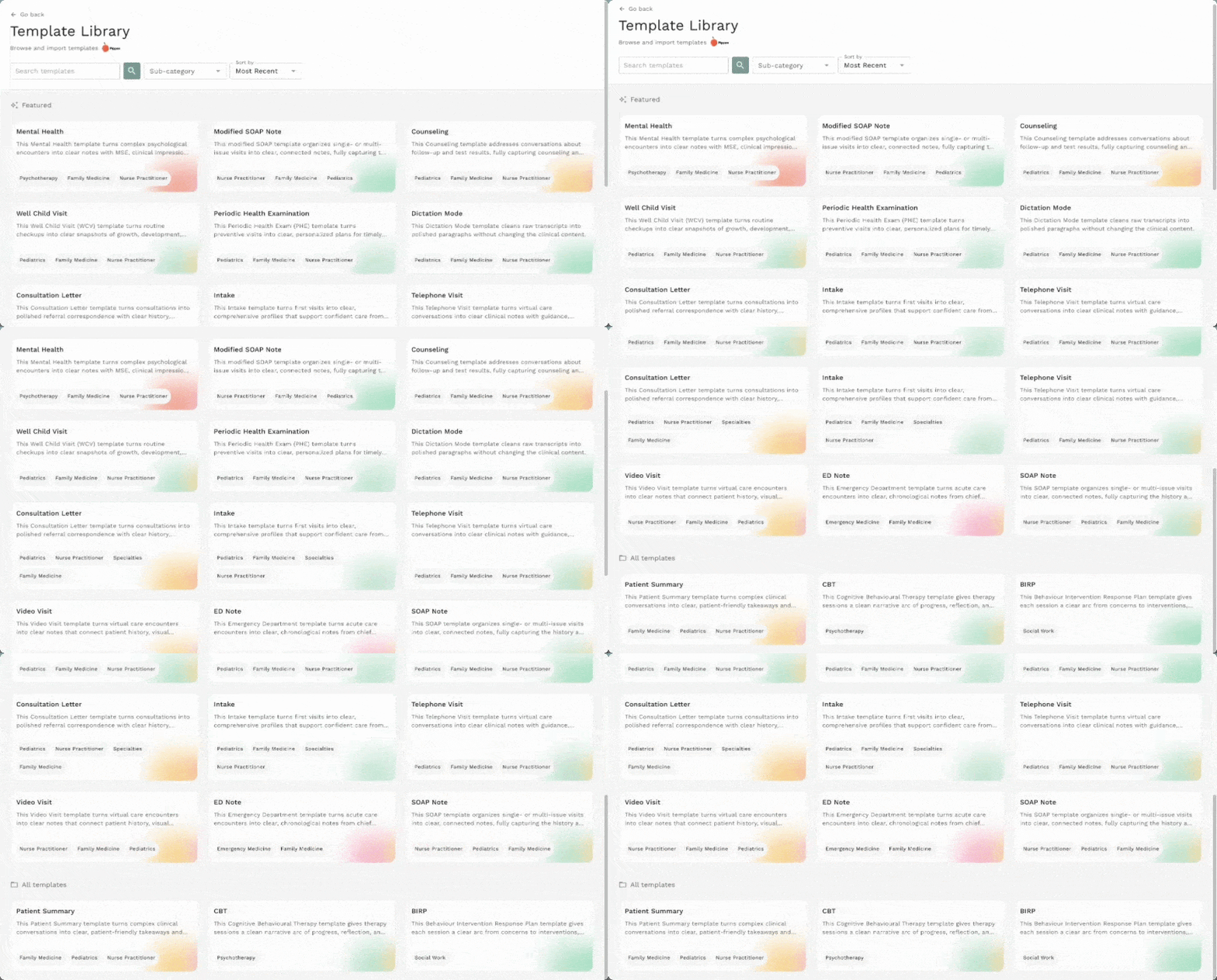
The Template Library isn't a read-only catalog — it's a fully interactive documentation system.
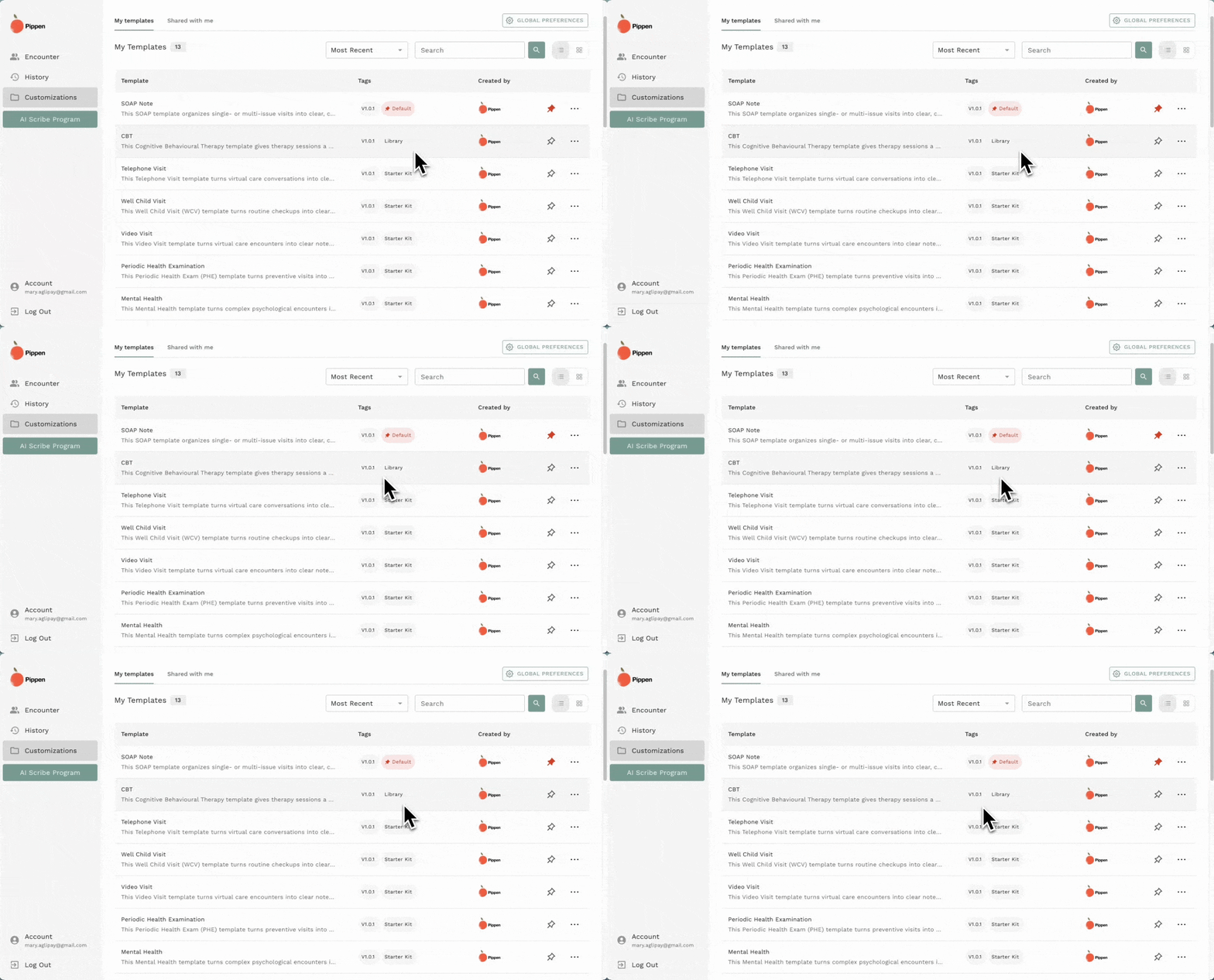
Physicians can browse the library and import any template into their personal My Templates collection with a single click, then use it as-is or customize it to fit their specific workflow. For workflows the library doesn't cover yet, physicians can build templates from scratch — structuring exactly the output format they want. Existing templates can be duplicated, renamed, reordered, and fine-tuned at any time.
If a library template gets updated by the Pippen team, users can reimport it to stay current without losing their saved customizations.
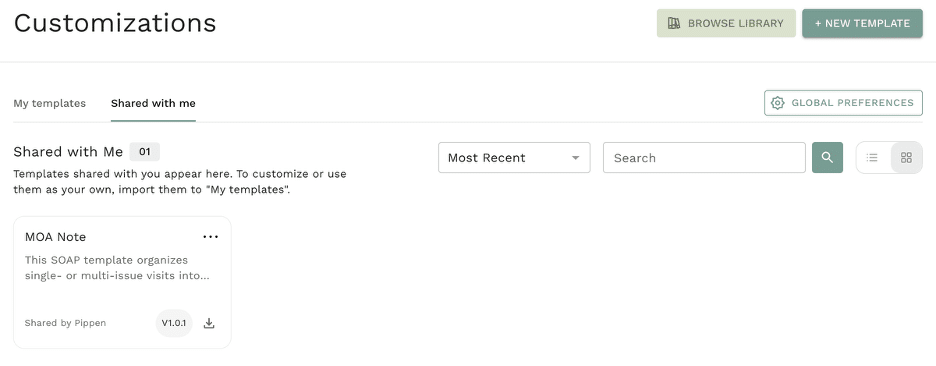
One of the most powerful additions is team sharing. A physician or clinic lead can share any template directly with colleagues inside the platform — no email threads or manual copy-paste required. When a template is shared, the recipient receives an in-app notification and can immediately start using it. For group practices, this means documentation consistency across an entire team with almost zero coordination overhead.

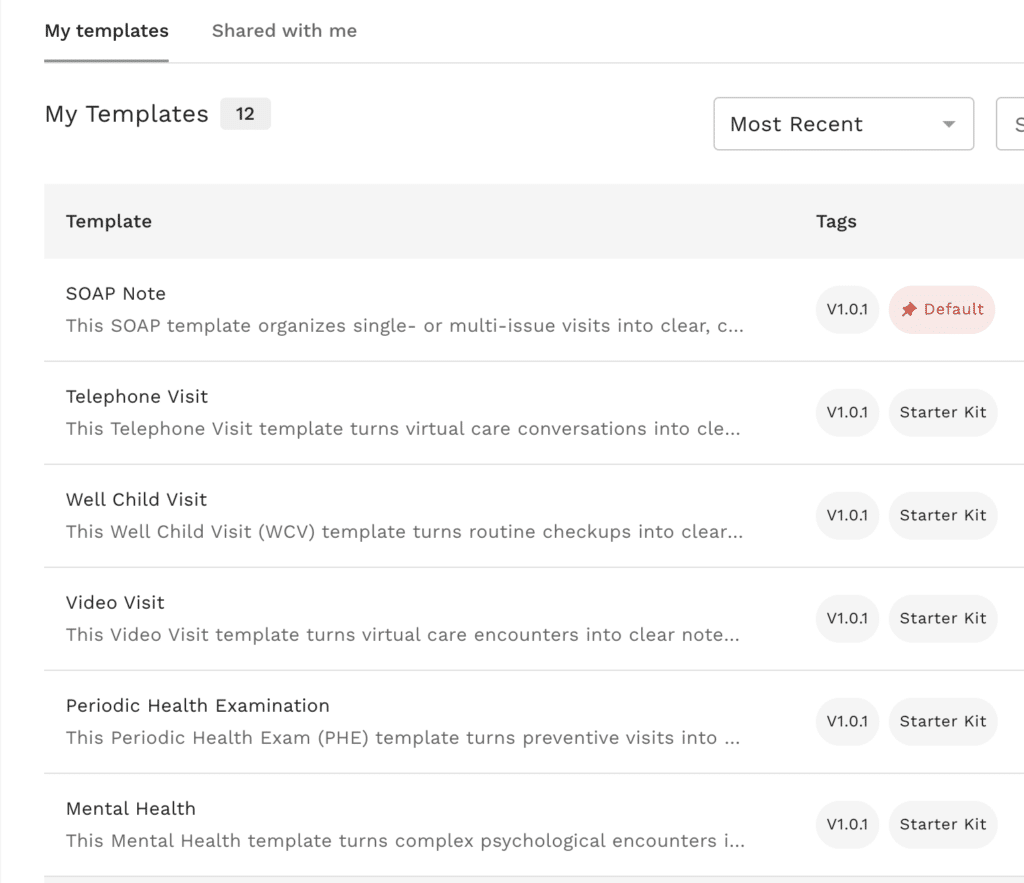
For physicians who want maximum efficiency, the Template Library also supports setting a default template — Pippen automatically applies the right format to the right encounter type every session, with no manual selection needed. Combined with Global Preferences that let users configure their documentation style account-wide, it becomes possible to open Pippen and have your notes structured exactly the way you want them, every time.
Dr. Kadhim-Saleh walks through the full Template Library feature set in the video below — including how to browse templates, build your own, and share them across a clinic team.
The Template Library launch is the latest milestone in a product that has been compounding in value since it first launched. In the last year alone, Pippen has:
Each of these additions makes the whole platform more useful. The Template Library is particularly powerful in that way: it doesn't just add a feature, it makes every clinical encounter in Pippen better.
If you're building in healthcare — or in any professional domain where smart, experienced people are losing hours every week to documentation — the Pippen story holds a few things worth noting.
Domain expertise closes the loop. Pippen works because it was designed by someone who runs clinical encounters every week. The templates in the library feel right to physicians because they were shaped by one. Technology alone doesn't get you there.
Compliance unlocks opportunity. PHIPA compliance and Canadian data residency weren't afterthoughts — they were foundational decisions that opened doors, including Canada Health Infoway. In regulated industries, doing compliance properly early is a competitive advantage.
Features compound. The Template Library isn't standalone — it makes everything that existed before more valuable. Notes that were already fast are now consistently structured, shareable, and tailored. That's the kind of product architecture worth building toward.
For our team at Crowdlinker, partnering with Pippen has been one of the more meaningful projects we've worked on. When the thing you're building directly reduces burnout and creates space for better patient care, that motivation is felt throughout the work.
If you're building a product that takes on a real, stubborn problem in your industry, we'd love to hear about it.



.png)