view case


Netsweeper is a Waterloo, Ontario company best known for carrier-grade web filtering for education, government and telecommunications. nsClear is a different kind of product from the same team: a platform that lets governments calculate and collect sales tax on online purchases at the moment of payment, including purchases from sellers in other countries. Crowdlinker has designed and built the nsClear web portal with Netsweeper since 2017.
Scale-up
Government Technology
UX/UI Design, Web Application, API, Reporting

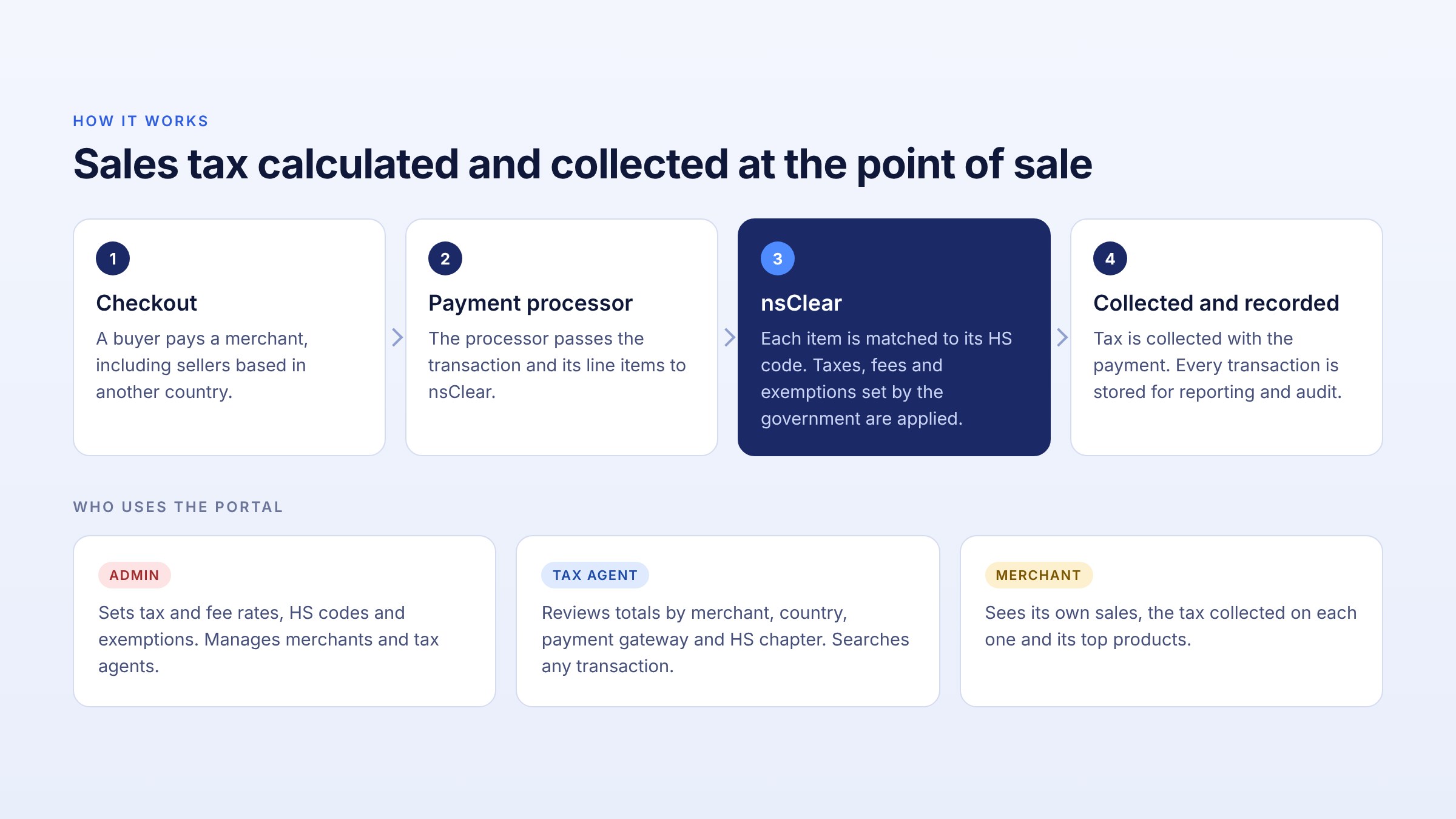
When someone buys from an online seller in another country, the buyer's government often has no practical way to collect the sales tax it is owed. The seller sits in a different jurisdiction, may never register for a tax account, and reports what it chooses. Governments lose revenue, and it is unclear who sold what to whom. nsClear moves the calculation to the point of sale. It works at the payment processor, so tax is worked out and collected as the payment happens, and individual merchants no longer need to register with each government.
Netsweeper had an early merchant and customs reporting tool and a clear idea of what nsClear should become. It needed a partner that could turn requirements into a designed, tested product on a fixed timeline, in the same time zone, working in the agile way its own teams did. Like most technology companies, it could not easily hire that team itself.
The domain is unforgiving. Tax rules vary by product, so every item has to be tied to a Harmonized System (HS) code. Some goods and some buyers are exempt. Several kinds of users need different views of the same data. And because the numbers are tax revenue, every rate change and every transaction has to be traceable if a dispute comes up.
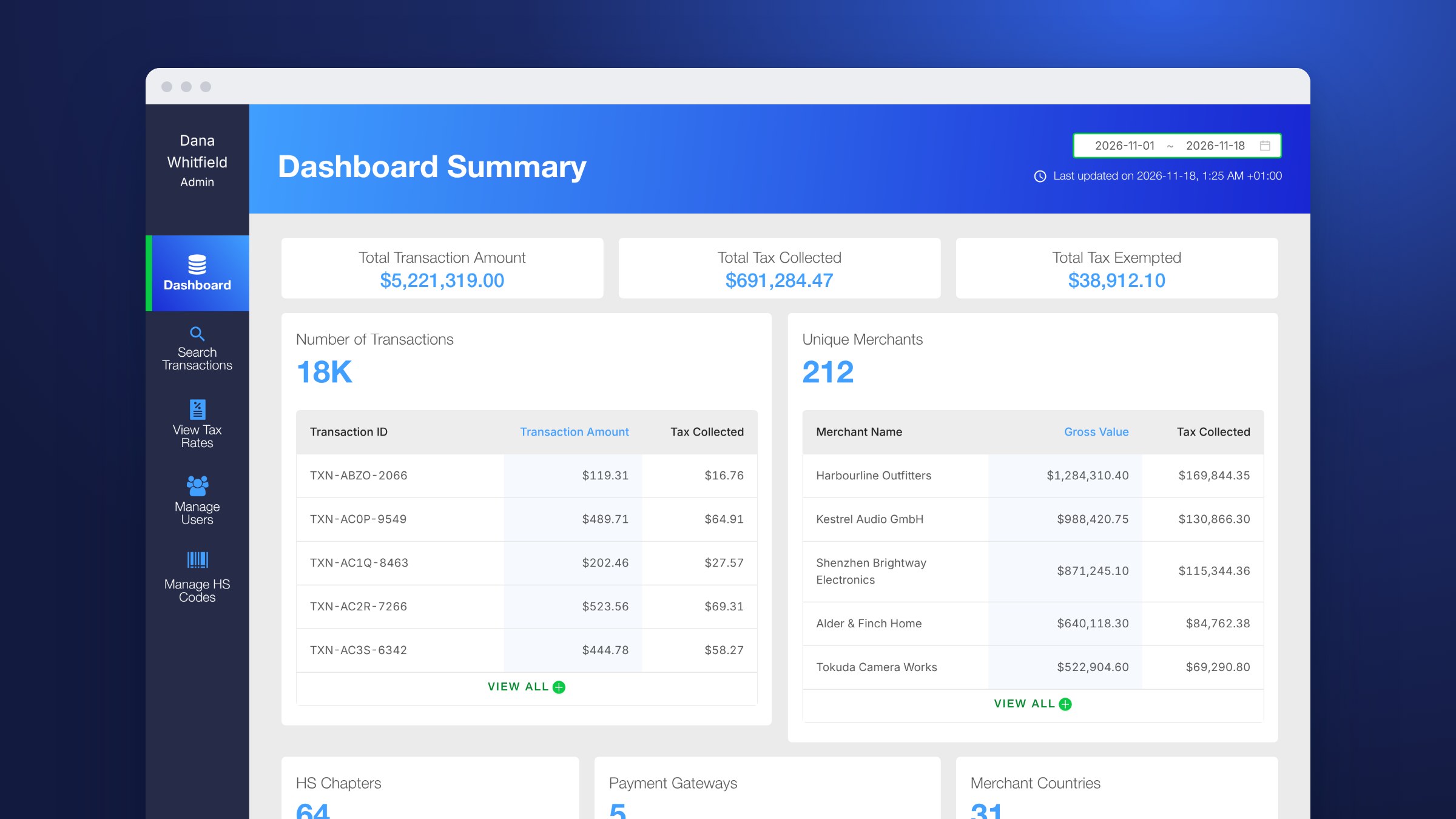
We began in 2017 with working sessions to pin down the requirements, then redesigned the interface and the user journeys from the ground up. The first phase delivered a responsive portal with dashboards and reports: sales and tax collected by merchant, country, product category and payment gateway.
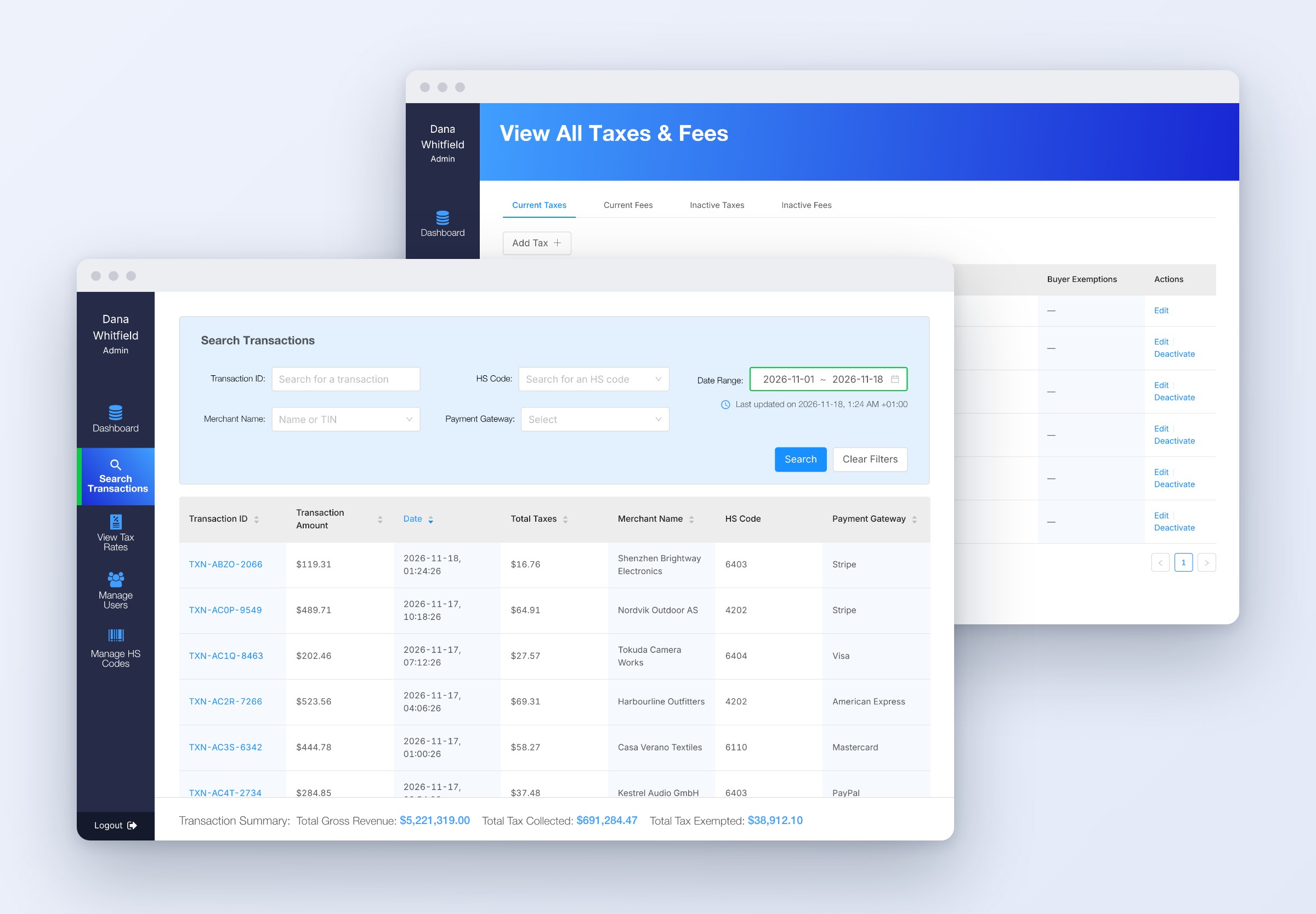
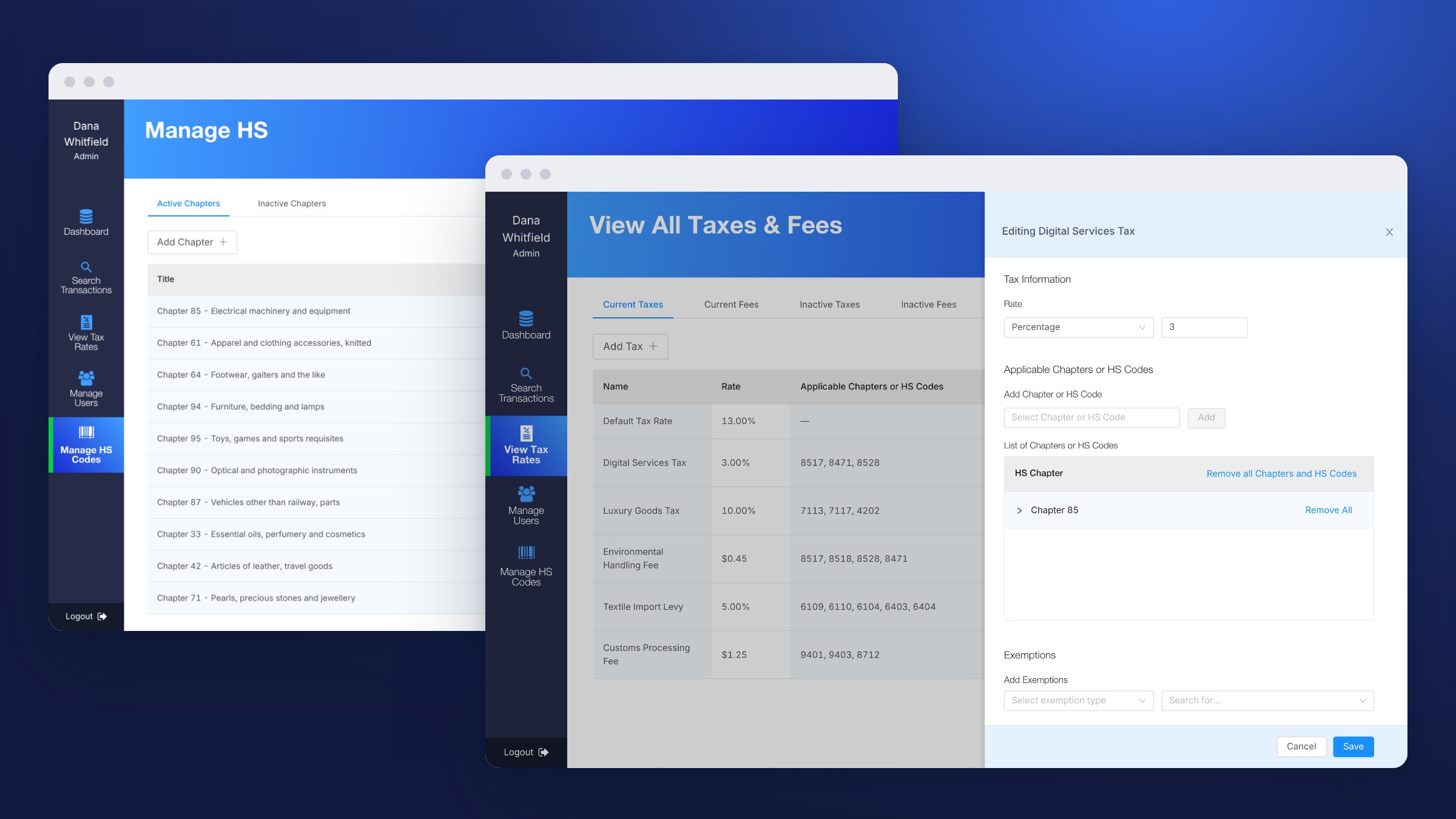
In 2019, phase two rebuilt nsClear as a React and TypeScript application on a NestJS API. The portal serves three roles. Administrators set tax and fee rates as a percentage or a fixed amount, apply them to HS chapters or individual codes, and grant exemptions by product or by buyer. Tax agents review totals and search any transaction by ID, merchant, HS code, payment gateway or date. Merchants see their own sales and the tax collected on them.
Auditability shaped the build. Every change to a tax or fee is kept in a history with the user who made it, the time and the IP address. HS codes are managed in the portal and can be exported, and inactive taxes, users and chapters are archived instead of deleted. The system shipped in Docker containers with automated tests, a build pipeline and seed data, so Netsweeper could stand up a working demo environment on its own.
Edge cases came up as the rules met real scenarios. Each time, we brought the case to Netsweeper with a recommendation instead of guessing. In 2026 Netsweeper brought Crowdlinker back for a new phase: support for the UNSPSC product classification alongside HS codes, a refreshed interface aligned with Netsweeper's current design system, and stronger account security.
The system was delivered on time and within budget. nsClear gave Netsweeper a complete, working product to put in front of government revenue authorities, one that shows how tax on cross-border purchases can be calculated, collected and audited in one place.
Netsweeper has used nsClear in demonstrations and proofs of concept to bring the idea to governments, and has kept investing in it. The code and documentation were handed over in full, and the same team is now building the next version.
Nine years after the first statement of work, Netsweeper is still building nsClear with Crowdlinker. For a product aimed at governments, where sales cycles are long and the requirements are exacting, that continuity means the team that knows the rules is the team extending them.
News & Media