view case



Kiaora is a telehealth company offering personalized hormone care across the United States, including bioidentical hormone replacement therapy (BHRT), GLP-1 and thyroid programs. The business had grown on a low-code platform and needed a foundation that could support more programs, more practitioners and stricter compliance requirements. Kiaora brought Crowdlinker in as an embedded product squad to define and design that next platform across patient, practitioner and admin experiences, and then to redesign and launch its marketing website.
Scale-up
Health & Wellness
Product & Technical Discovery, Platform Architecture, UX/UI Design, Marketing Website


A telehealth care journey has many parts that must work together: intake questionnaires, identity checks, practitioner review, prescriptions, payments, messaging and ongoing follow-up. Kiaora ran all of it on Blaze, a low-code platform that had carried the company through its early growth but was not designed for where the business was heading. Kiaora wanted a custom platform that could support GLP-1, BHRT, thyroid and future programs on one foundation, without disrupting the patients and practitioners already in care.
The intake questionnaire sat at the center of the problem. Each program has its own clinical logic, and the new platform needed a questionnaire that could branch in non-linear ways and stay independent of individual products, so a new therapy would not mean a new intake build. Practitioners needed an efficient way to review patients, run virtual visits and keep charts current, and the operations team needed admin tooling of its own.
Migration raised the stakes. Kiaora wanted everything carried over, including patients in pending states, prescription history, SOAP notes and payment history. Any new system also had to respect healthcare privacy requirements such as HIPAA and connect to the tools the team already relied on for analytics, customer messaging and support.
We started with product discovery. Current-state workshops and a feature board mapped how the existing platform actually worked. We analyzed earlier user research and patient survey responses, reviewed competitors, interviewed patients, and mapped user journeys and flows for each role. A practitioner portal prototype was tested with physicians before designs moved forward.
In parallel, our engineers ran a technical discovery. We reviewed the existing codebase and data model, documented the therapy algorithm, and ran focused spikes on the decisions that carry the most risk in a telehealth product: identity verification, authentication, payments, video visits and messaging, scheduling, questionnaire logic and admin tooling. We also evaluated large language models for specific healthcare use cases.
That work produced the architecture for Kiaora's new platform: a microservice, event-driven system built around a state-driven care engine, with a questionnaire engine decoupled from individual products so new programs can be added without rebuilding intake. We defined MVP requirements for three portals (Patient, Practitioner and Admin) and a migration plan based on one principle: build it correctly for the future, then engineer the bridge from the old system.
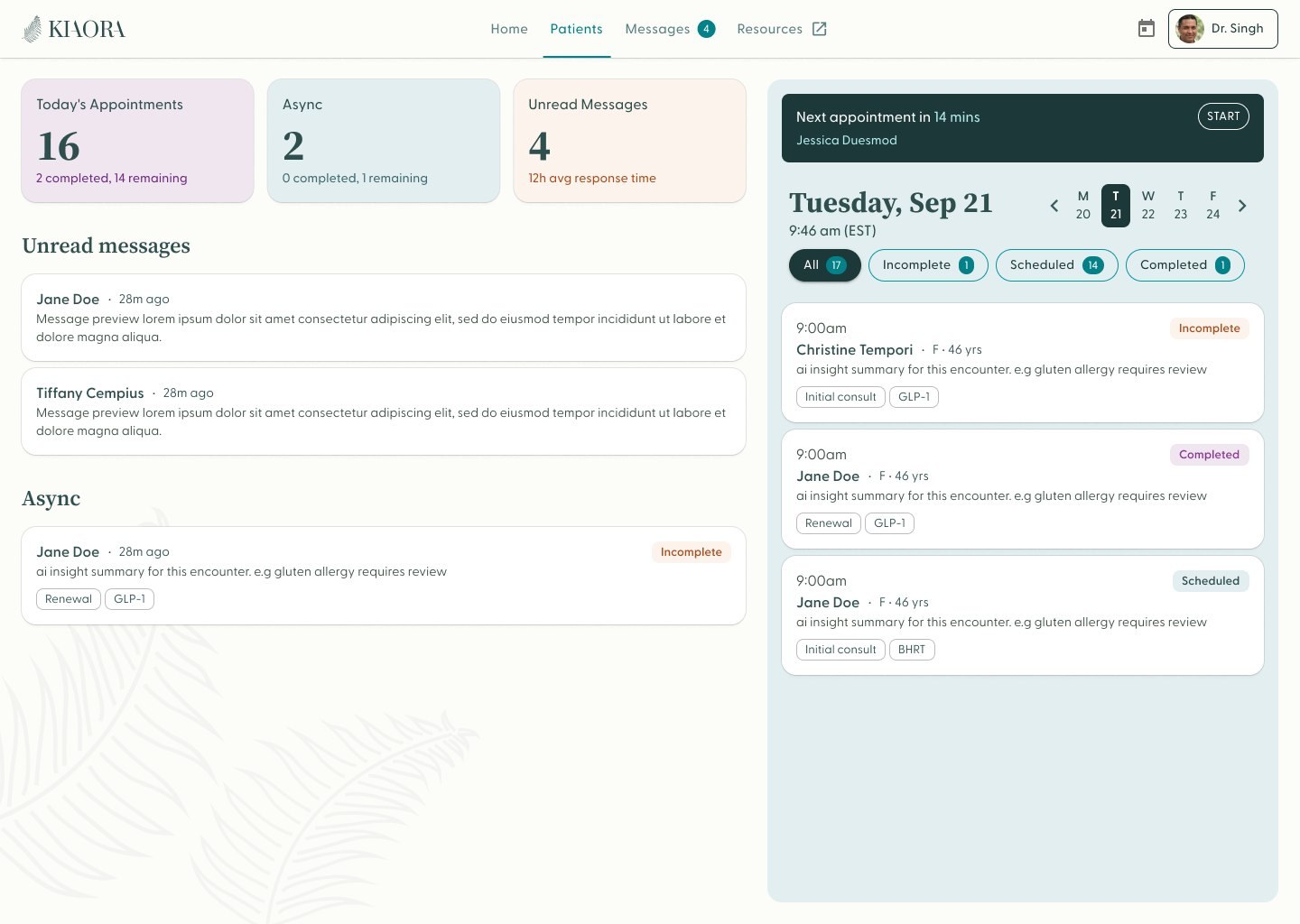
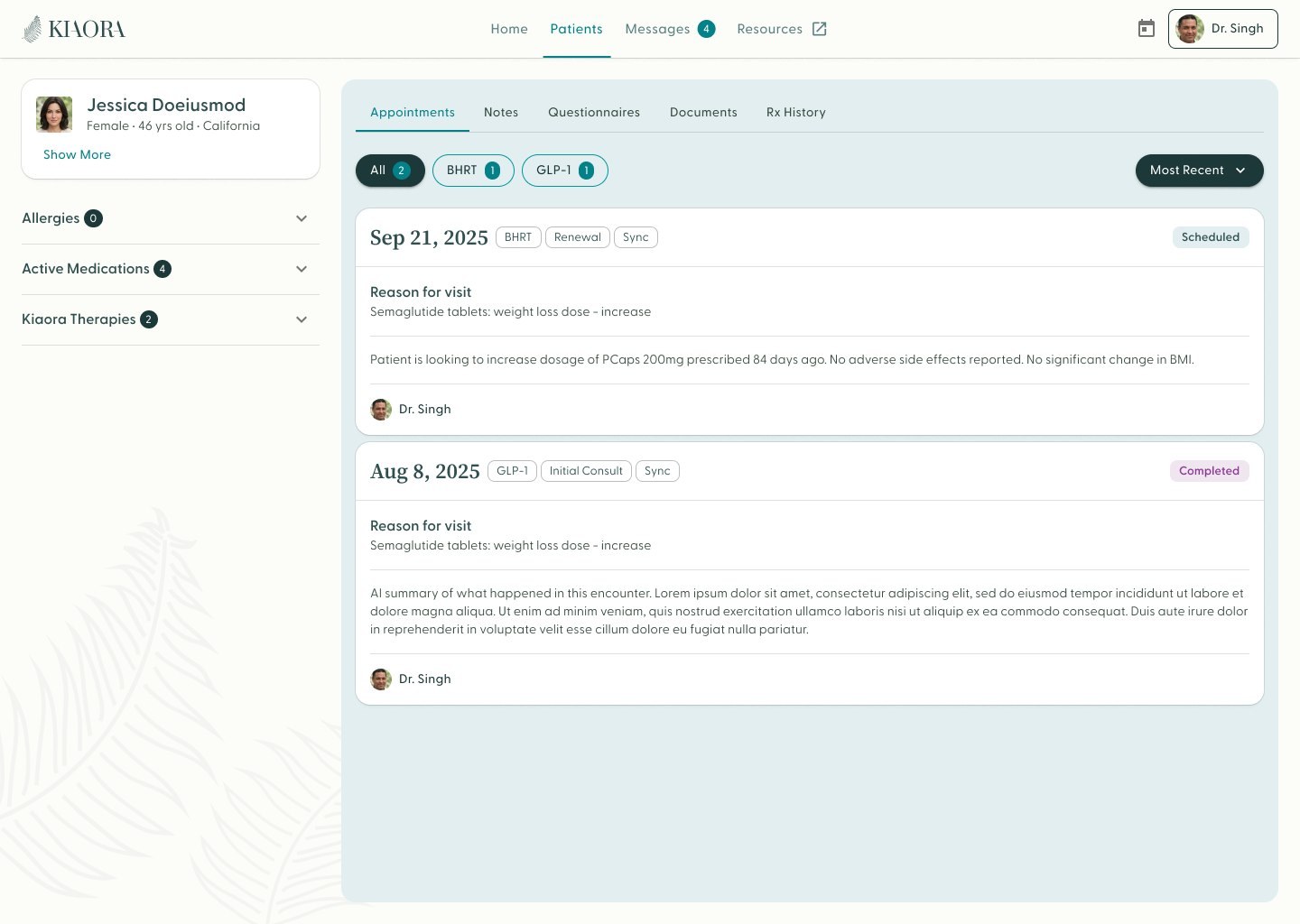
Design then moved to high fidelity. We explored visual directions for the portal, agreed a style with Kiaora and produced final designs for the practitioner experience, including the home dashboard and patient chart. In a separate engagement we redesigned Kiaora's marketing website, including the homepage and treatment pages, built it on Webflow and launched it in March 2026.
By the end of the engagement Kiaora had a complete, buildable definition of its next platform: MVP requirements for the patient, practitioner and admin portals, final high-fidelity designs shaped by testing with physicians, an architecture built around a state-driven care engine and a product-independent questionnaire engine, and a migration plan covering patients, prescriptions, SOAP notes and payment history. The design and architecture were handed over to Kiaora's team ready for build.
Alongside it, the redesigned marketing website went live in March 2026 at kiaora.com, with a new homepage and treatment pages for Kiaora's programs.

Kiaora's clinical, operations and leadership teams now work from one documented picture of how care moves from intake to follow-up. Adding a program becomes a matter of configuration, and the decisions that carry the most risk in a telehealth build were researched and settled before any production code was written.
News & Media