view case



Allied Technical Solutions (ATS) builds software for the commercial construction industry. Its spec-to-quote product, Quoti, helps teams get from a project's specifications and drawings to a quote. ATS partnered with Crowdlinker to build the AI service underneath Quoti: a production-grade microservice that reads construction PDFs and returns the products they call for as structured data. It is live with ATS customers today.
Scale-up
Construction Technology
AI Proof of Concept, Document Extraction Microservice, API
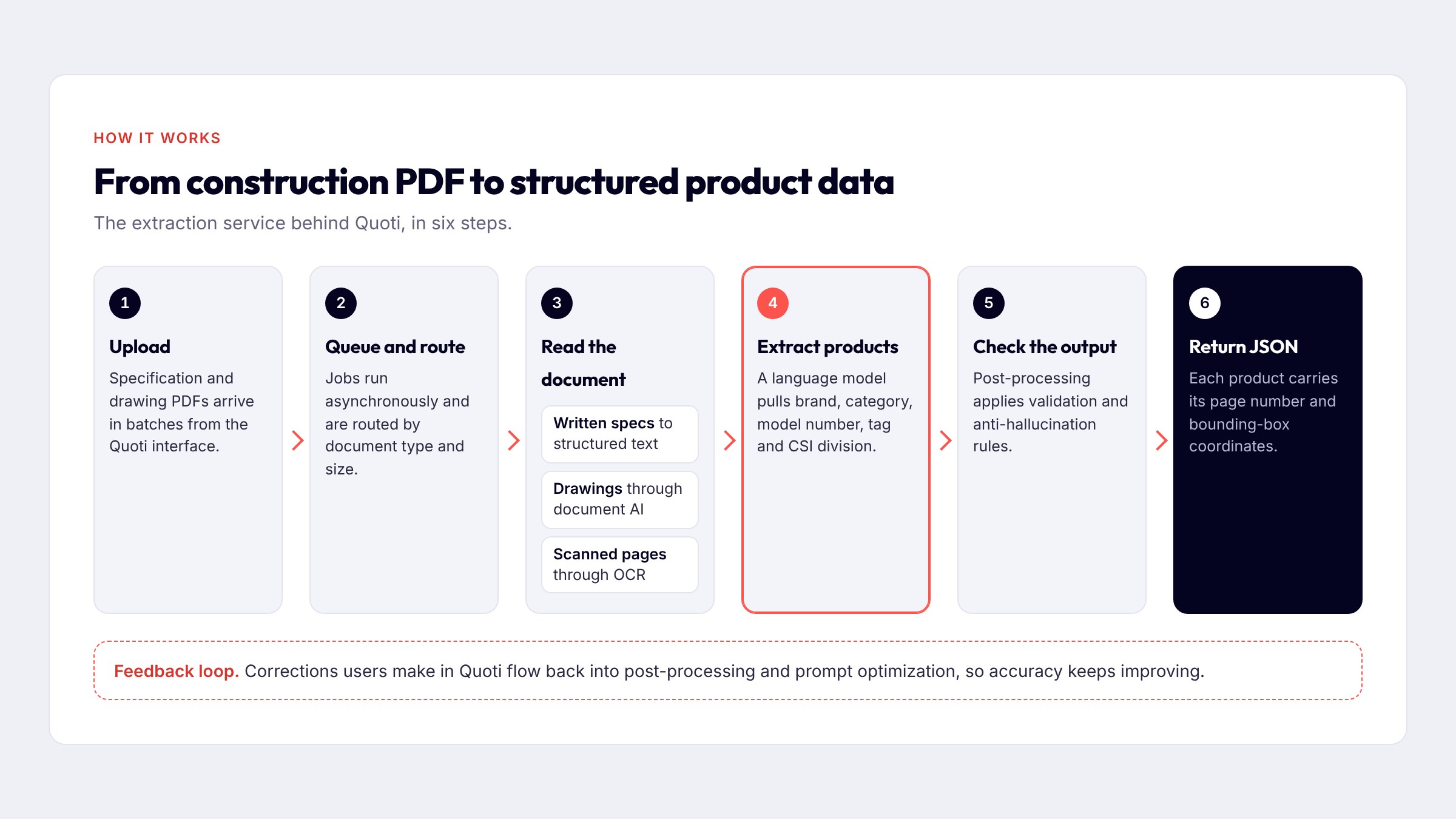

Before anyone can quote a commercial construction job, someone has to read the documents. Written specifications are long, and drawings carry product schedules, tags and callouts inside tables and diagrams. Finding every product, its manufacturer, its model number and the right CSI MasterFormat division is slow manual work, and a missed item affects the quote. ATS wanted to automate that first pass so its users could start from a product list instead of a stack of PDFs.
Construction documents are not written for machines. A single upload can mix dense text, multi-column tables, scanned pages and drawings where the information that matters sits inside a diagram. General-purpose OCR and off-the-shelf LLM prompts each handled part of the problem and failed on the rest.
The bar was explicit. ATS needed accuracy it could measure, so the service was benchmarked on F1 score against labeled ground-truth files, with targets of 80% for written specifications and 87% for drawings. It had to be fast enough to sit inside a product workflow, with targets of about one minute for a 100-page specification and two minutes for a 20-page drawing set, and it had to return clean JSON that ATS's own front end could present.
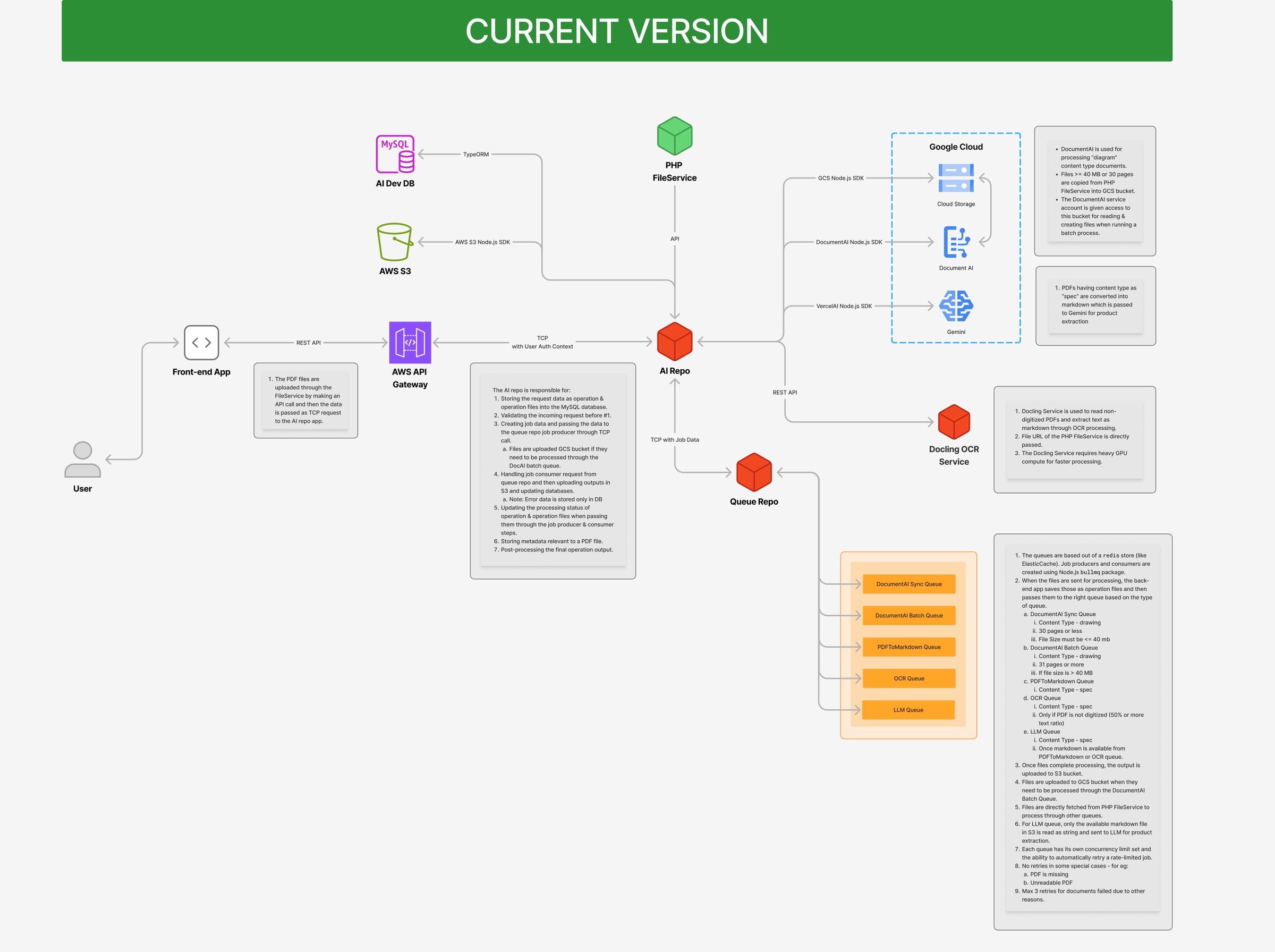
We began with a proof of concept to test whether extraction was feasible at the accuracy ATS needed, then moved into a phased build. The service is a NestJS microservice that accepts batches of PDFs, queues them and processes them asynchronously. Each file is routed by type. Written specifications are converted to structured text and passed to a large language model for product extraction. Drawings go through a document AI pipeline tuned for diagrams. Scanned pages go through OCR first.
Reaching production accuracy was an evaluation problem as much as an engineering one. We measured every change against labeled ground-truth files and compared OCR engines, layout parsers, language models and prompt strategies head to head: Google Document AI, Azure Document Intelligence, PaddleOCR, PaddleOCR-VL, Docling, OCRFlux, MinerU, LandingAI, Gemini 2.5 Pro and Claude Sonnet. Computer-vision preprocessing crops each PDF to the pages and regions that matter before extraction. We also assessed fine-tuning and retrieval-augmented approaches and costed each one before recommending a path.
The second phase made the output easier to trust and act on. Every extracted product carries its page number and bounding-box coordinates, so ATS's interface can jump to the exact place in the document and highlight it. A feedback loop captures user corrections on the extracted product list and feeds them into post-processing and prompt optimization, alongside explicit rules that reduce hallucinated products.
Because accuracy depends on the quality of the answer key, we also audited the ground-truth data itself and reported inconsistencies back to ATS, so both teams were measuring against the same standard.
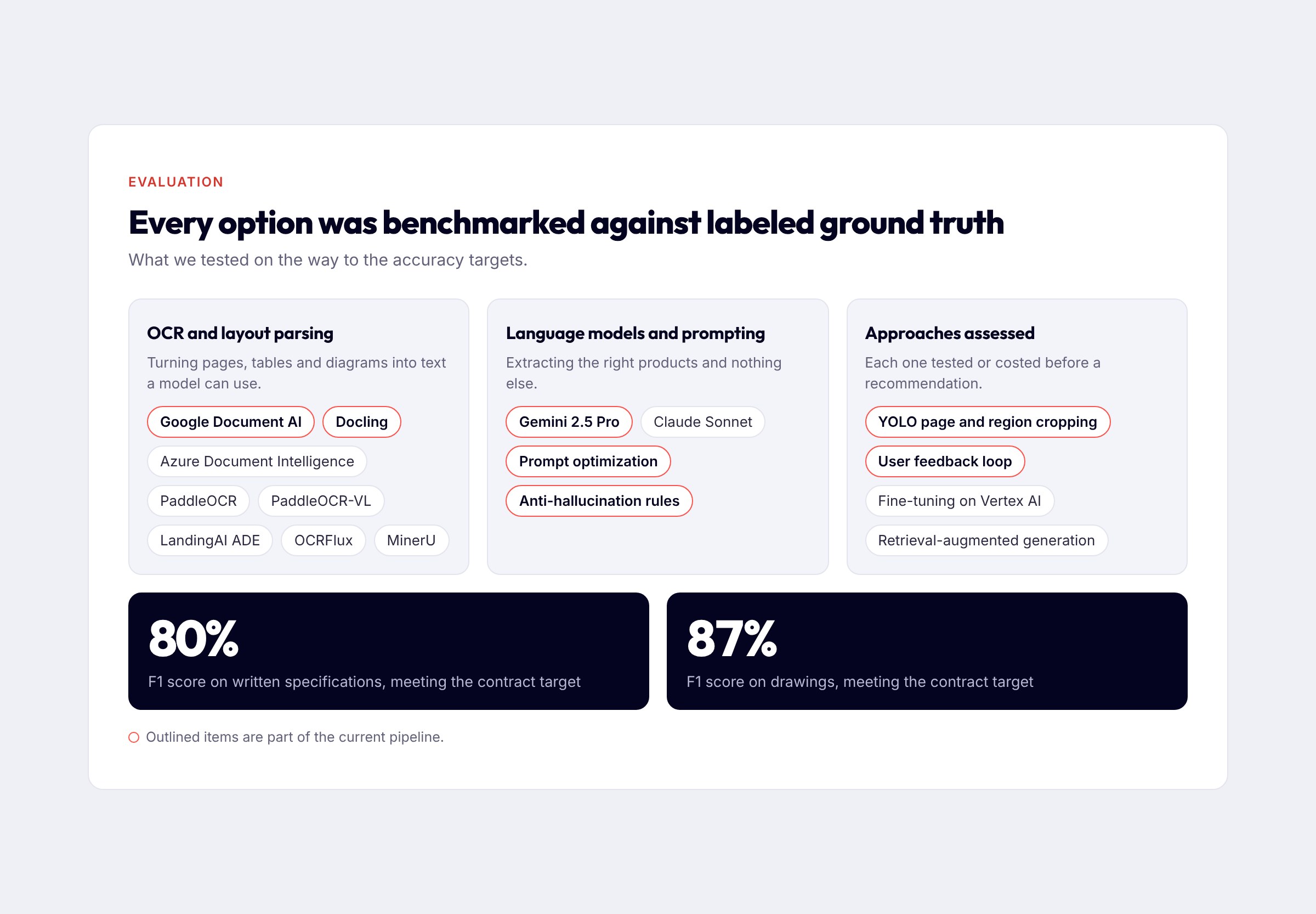
After multiple iterations and benchmark runs, the service reached the contract targets: an F1 score of 80% on written specifications and 87% on drawings. Quoti is live with ATS customers today. PDFs go in, and a structured list of products comes back with brand, category, model number, tag, CSI division and the location of each item in the source document.
Work that used to start with a person reading every page now starts with a product list that points back to its source. The benchmark that proved the targets stays in place, so ATS can test new models and parsers as they are released and know whether they are better.
News & Media